Showing posts with label democrat. Show all posts

Sunday, January 15, 2012

A Look Into History: U.S. Presidential Election of 1852


After Zachary Taylor died all of a sudden, Vice President Millard Fillmore became president. However he lost the nomination due to regional differences among the Whig party part of which led to it's collapse. 


Whigs nominated Winfield Scott, a heroic war general from the Mexican-American war. 


 Democrats nominated Franklin Pierce, former Senator and General. Because of the similar platforms of the parties, and of the candidates turnout was low. Making it one of the first elections where many were dissatisfied with both choices.


Despite not much campaign conflict and close popular vote, Pierce had a landslide victory. He received 254 votes in comparison to Scott's 42. 

Friday, January 13, 2012

A Look Into History: U.S. Presidential Election of 1848


The election of 1848 was open after Polk kept his promise not to re-seek office after just one-term. Zachary Taylor was the war hero and general during the Mexican-American war, and was sought out by both parties to run. The Whigs managed to get him to come their side.


The Democrats nominated Lewis Cass, a senator from Michigan. 


Former President Martin Van Buren was at it again, and sought another term. Except this time he ran on a 3rd party ticket. He ran on the Free Soil platform which opposed slavery in the expanding west. 


Also to note is that Van Buren's running mate was Charles Francis Adams who was the grandson of John Adams, and son of John Quincey Adams. The Free Soil party received no electoral votes. 


The Whigs and Democrats attacked each other with the same old rhetoric since this was an open election. It's hard to verbally-attack a president that's not running again. However Taylor's popularity as a war hero gave him a victory over Cass. Taylor beat Cass 163-127 with them winning 15 states each. Taylor managed to get the ones that were worth more.

Wednesday, January 11, 2012

A Look Into History: U.S. Presidential Election of 1844


 Even though Harrison managed to beat Van Buren in a impressive election last time, he died shortly after taking office. His vice president John Tyler became president after that. Except he wasn't very popular and dropped out of the general election.


Democrats then threw their support to James K. Polk, the former Governor of Tennessee. 


Martin Van Buren tried to get the Democratic nomination, but failed in the long-run to Polk.  Though pretty rare for a former president to seek a nomination after losing.


Senator Henry Clay once again tried to become president by becoming the Whig candidate.  The main issue of the campaign was the issue of Western expansion and the annexation of Texas. Which Polk supported, and Clay had a weak stance on.

Despite a rather odd primary, the general election was rather bland and unbiased in comparison to recent elections. Therefore it was rather half and half. The popular vote was close between Polk, and Clay, however Polk had the obvious edge in the electoral vote. Polk beat Clay 170-105.

Monday, January 9, 2012

A Look Into History: U.S. Presidential Election of 1836


Jackson decided to retire after 2 terms, so Vice President Martin Van Buren decided to run as a Democrat. 


By this time the Whig Party had formed, and they had a interesting strategy for this election. They elected two nominees, the first being William Henry Harrison. Harrison was suppose to defeat Van Buren in the Northern States. 


While Hugh Lawson White was suppose to defeat Van Buren in the Southern States. The Whig Party would then pick the better of the two if Van Buren lost. Daniel Webster and Willie Person Magnum took a state each as a presidential candidate. They campaigned hard against Van Buren and even upset the Senate in which he was in charge of.


Because of the bizarre nominee practice, the Vice President race was thrown into the Senate. Richard M. Johnson got the most, but not the up-most majority.


 Despite that, Johnson was easily elected in the Senate versus Whig Francis Granger.


The odd strategy proved to be an easy victory for Van Buren. A split Whig vote left him 170 electoral votes versus Harrison's 73, White's 26, Webster's 14, and Magnum's 11.

Sunday, January 8, 2012

A Look Into History: U.S. Presidential Election of 1832


The 1832 election saw Jackson's attempt to get a 2nd term as president. He ran on the Democratic party ticket. 


Former Speaker of the House, and then-Senator Henry Clay became the National Republican nominee. His successful attempt to deny Jackson his first presidential win 8 years before brought this election into a fitting political battle.


 William Wirt also ran on the Anti-Masonry party. They were a single-issue party who were opposed to the Freemason society.


 John Floyd was also listed as a nominee for the Nullifier party, a short-lived states rights party.


The main issue of the campaign was against Jackson's veto against the renewing the charter for the 2nd Bank of the United States (similar to the present Federal Reserve) with him being portrayed as being "too powerful". Jackson denied this and went on a platform about protecting citizens from being ruled by a rich elite within the 2nd Bank of the United States.


Despite some strong tactics by Clay, it was an almost all out win for Jackson. Jackson had 219 electoral votes versus Clay's 49. Floyd got 11, and Wirt got 7 which is admirable for distant 3rd parties.

Thursday, January 5, 2012

A Look Into History: U.S. Presidential Election of 1828


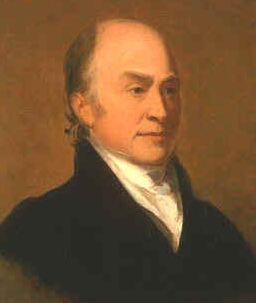
John Q. Adams ran again to seek a 2nd term after being made president thanks to Anti-Jackson politicians in the House of Representatives.


Shortly after Adams term begun, Jackson was practically nominated with no challenger to take Adams on again. Adams was also nominated with no formal process.


The Democratic-Republican party by this time pretty much spilt in two. The ones who supported Jackson called themselves Democrats, and thus formed the party that stands today. Those who supported Adams became the National Republicans which later turned into the Whig Party.


Ironically Adam's Vice President John C. Calhoun did not become his running mate. He joined Jackson's ticket and became a Democrat.


 Secretary of the Treasury Richard Rush became Adam's running mate.


This election marked the first major event of mudslinging in presidential politics. Adams' campaign pressed the issue of Jackson's marriage to his wife not being legal since there was trouble of getting a final divorce from her first marriage. Jackson's campaign fired back with accusations of governmental corruption committed personally by Adams.


Regardless of campaign tactics, it was a clear-cut victory for Jackson. Jackson carried 56% of the popular vote, 178 electoral votes, and 15 states. Adams had only 43.6% of the popular vote, 83 electoral votes, and carried only 9 states.

Friday, October 15, 2010

MoveOn.org Terrorizing Target?

The White House is escalating its assault on corporate political donors, claiming that Democrats merely favor "disclosure." To understand their real goal, consider what happened to Target Corp. when it exercised its First Amendment rights in Minnesota.


In July, the superstore retailer based in Minneapolis donated $150,000 to an independent group called MN Forward, which used the funds to support the primary candidacy of Republican gubernatorial candidate Tom Emmer. Consistent with Target's interest, the donation helped pay for an ad highlighting Mr. Emmer's positions on taxes and spending, issues relevant to the state's business climate. Because Mr. Emmer was also a critic of gay marriage, however, within weeks the retailer found itself on the national left's political hit list.

MoveOn.org led the attack, organizing a petition and crafting a TV ad telling shoppers to boycott the chain. Soliciting donations to the anti-Target crusade, MoveOn warned that "Target became one of the first corporations to take advantage of the Citizens United decision when it donated to a far-right candidate for governor in Minnesota." It added, "If we don't fight back, this will be just the tip of the iceberg." Citizen's United is the January Supreme Court decision that said unions and companies can donate to independent political groups, which is what Target did.
CONTINUED

Friday, July 30, 2010

Rep. Anthony Weiner Goes Bazerk on House Floor


Here is another instance where Weiner goes kinda nuts on the House floor:


If you want to view even more of  Rep.Weiner's nuttiness you can see more evidence here.